


LlamaIndex: connect your internal data to generative AI

Discover LlamaIndex, the framework that links AI to your data
LlamaIndex is an open source framework specialised in connecting large language models to your company's data.
Your contracts, procedures, meeting notes and document libraries sit scattered across folders and tools. LlamaIndex ingests them, indexes them and lets an AI assistant draw its answers from them: it is the software layer that turns a general-purpose model into an expert on your business.

LlamaIndex is built around four pillars:
Together they cover the full chain of a RAG (Retrieval-Augmented Generation) application.
1. Ingestion: connect your data sources
Step one, getting your content into the pipeline, whatever its format.
- Connect your sources: files, databases, SaaS tools, websites
- Handle common business formats: PDFs, presentations, spreadsheets
- Split documents intelligently into chunks the models can work with
- Automate pipeline updates as your content changes
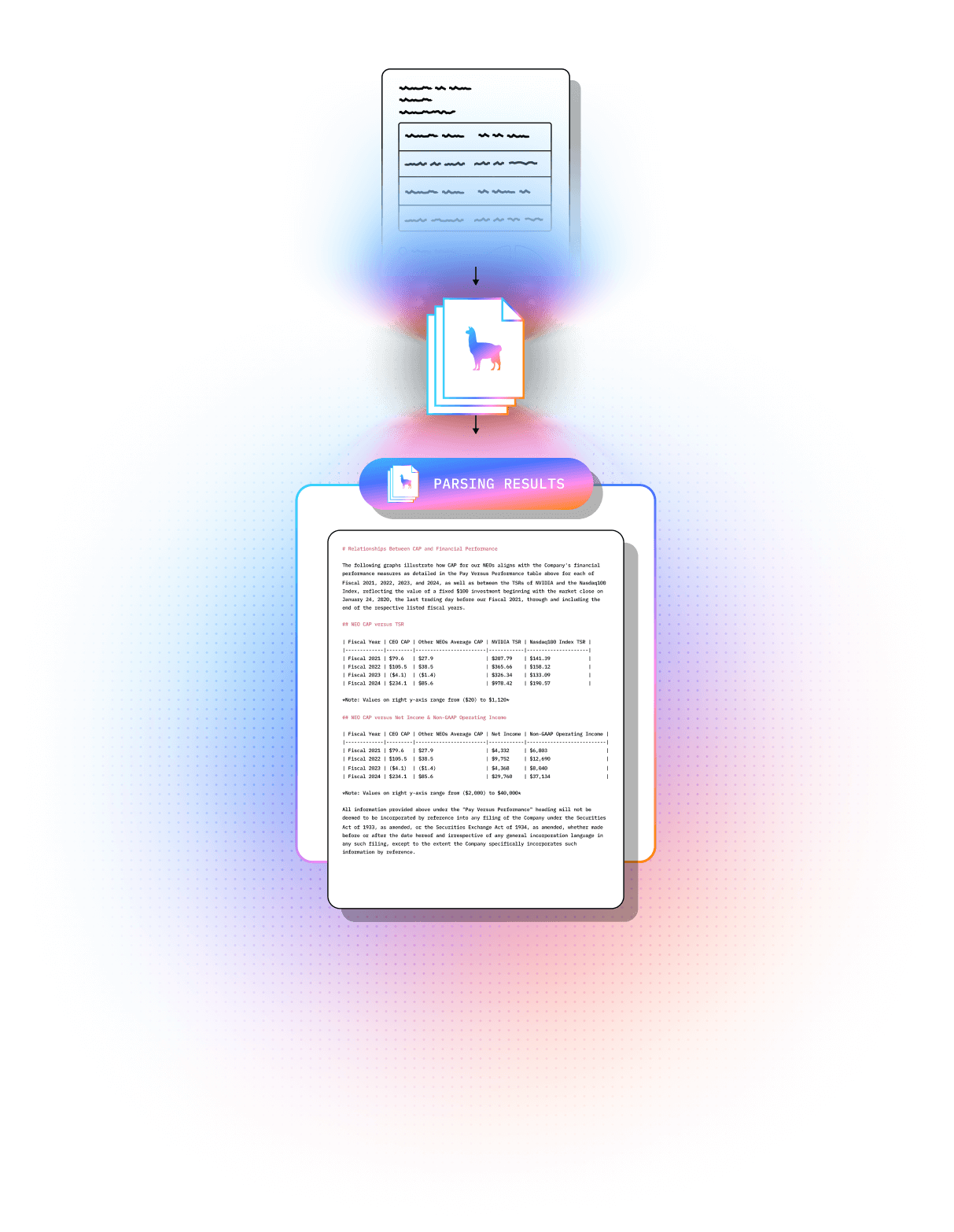
2. Indexing: structure knowledge for AI
Ingested content is turned into indexes that models can query.
- Generate embeddings and store them in the vector database of your choice
- Combine several index types depending on the nature of your data
- Plug LlamaIndex into Pinecone, Qdrant, Weaviate or PostgreSQL
- Keep the freedom to switch models or databases without rebuilding everything
3. Querying: answers grounded in your documents
The heart of RAG: retrieving the right passages and handing them to the model so it answers accurately.
- Query your document base in natural language
- Feed the model the relevant sources to ground its answers
- Show the cited documents so users can verify
- Tune the retrieval strategy to the level of precision required
4. Agents: automate document workflows
Beyond Q&A, LlamaIndex lets you build agents that chain steps together.
- Build agents that search, compare and summarise multiple sources
- Orchestrate multi-step workflows: extraction, analysis, drafting
- Combine several tools and sources within a single reasoning flow
- Keep agents in check with validation steps
What about LangChain?
LlamaIndex and LangChain are often compared: the former excels at data ingestion and querying, the latter at orchestrating complex applications. In practice, the two combine very well within the same architecture.
Planning an AI assistant on your own data? turnK designs your RAG pipeline end to end, from document preparation to deployment. Take a look at our Data & AI services or contact us: our consultants reply within 48 hours.
Frequently asked questions.
LlamaIndex is an open source framework specialised in connecting large language models to a company's data. It covers document ingestion, indexing and querying to build RAG applications, where AI answers from internal knowledge.
Developers and data teams building AI assistants grounded in company documents: internal support, document search, contract analysis. It is a technical tool, aimed at profiles comfortable developing in Python or TypeScript.
Connectors to many data sources, document chunking and indexing, natural-language querying with source citation, and agent building for multi-step document workflows.
The framework is open source and free. The company also offers paid managed services, billed on usage, for document parsing and pipeline management. Up-to-date pricing is available on the official website.
LlamaIndex is particularly strong at ingesting and querying document data, LangChain at orchestrating complex applications and agents. The two are often combined; turnK helps you choose the right architecture for your use case.
