



Develop without programming: it is possible with no-code!
The health crisis and the rise of no-code / low-code.
For the past two years, the tech world has been facing a real acceleration in the digital transformation of companies. This is one of the main consequences of the health crisis, business leaders whether they are digital or not have turned to new solutions to develop their business and improve internal collaboration within their teams: digital solutions. The budgets devoted to digital transformation both at the level of infrastructure, applications and security have been strengthened.
According to AppDynamics, a U.S. publisher who conducted nearly 1,000 interviews with IT professionals, 74% of technologists said that digital transformation projects, usually validated over more than a year, were approved in a few weeks. This is because of the health crisis. 71% of them also indicate that some projects were implemented in a few weeks, instead of the “months or years it would have taken before the pandemic.” In other words, "not time for planning cycles and complete proof-of-concept tests," the study summarizes.
Thus, the pressure on project deadlines, the lack of internal IT strategies, the lack of human resources in development, the implementation of telework have contributed greatly to the evolution of low-code / no-code market.
Low-code ≠ to no-code.
By using no-code, you do not need to have web development skills. No-code tools are previously encoded so that each of us can use them, they do not require mastery of the computer language. No-code masks users the complexity of an application's source code. The source code corresponds to all the instructions of a computer program written in a computer programming language. To understand the computer language, learning is necessary and not everyone has this knowledge. Training on code learning is mostly expensive and complex.
Thus, in recent years, alternative solutions have been put in place to make it accessible to as many people as possible create websites or applications while freeing themselves from traditional programming. Today, it is possible to create websites or applications simply through predefined, ready-to-use and customizable templates.
“Low-code/no-code technologies help businesses of all sizes meet the challenge of digital transformation, putting tools in the hands of business users to automate and innovate,” said Rebecca Wettemann, a technology analyst.
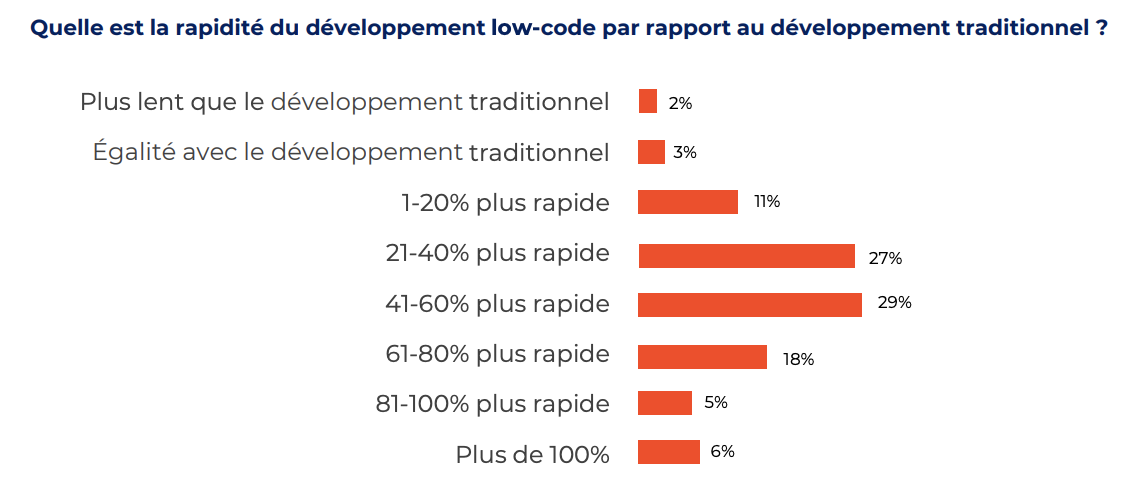
As mentioned just before, there are also many tools qualified as Low-code (little programming). Low-code is used in the same way as no-code, to create websites and applications. The difference being that with low-code, the user uses the programming language in such a way that they have more fields of possibilities than with no-code. The interest is to save time, because with low-code, the user does not code his platform from A to Z as traditional developers. Thus, development time is reduced and companies can focus on the most important tasks.
One of the most well-known examples using low-code is WordPress. You have certainly all heard about it, it is a CMS (Content Management System) to create custom websites. The main advantage of these tools is the acceleration of the time to market, followed by a reduction in the cost of developing applications or websites.