


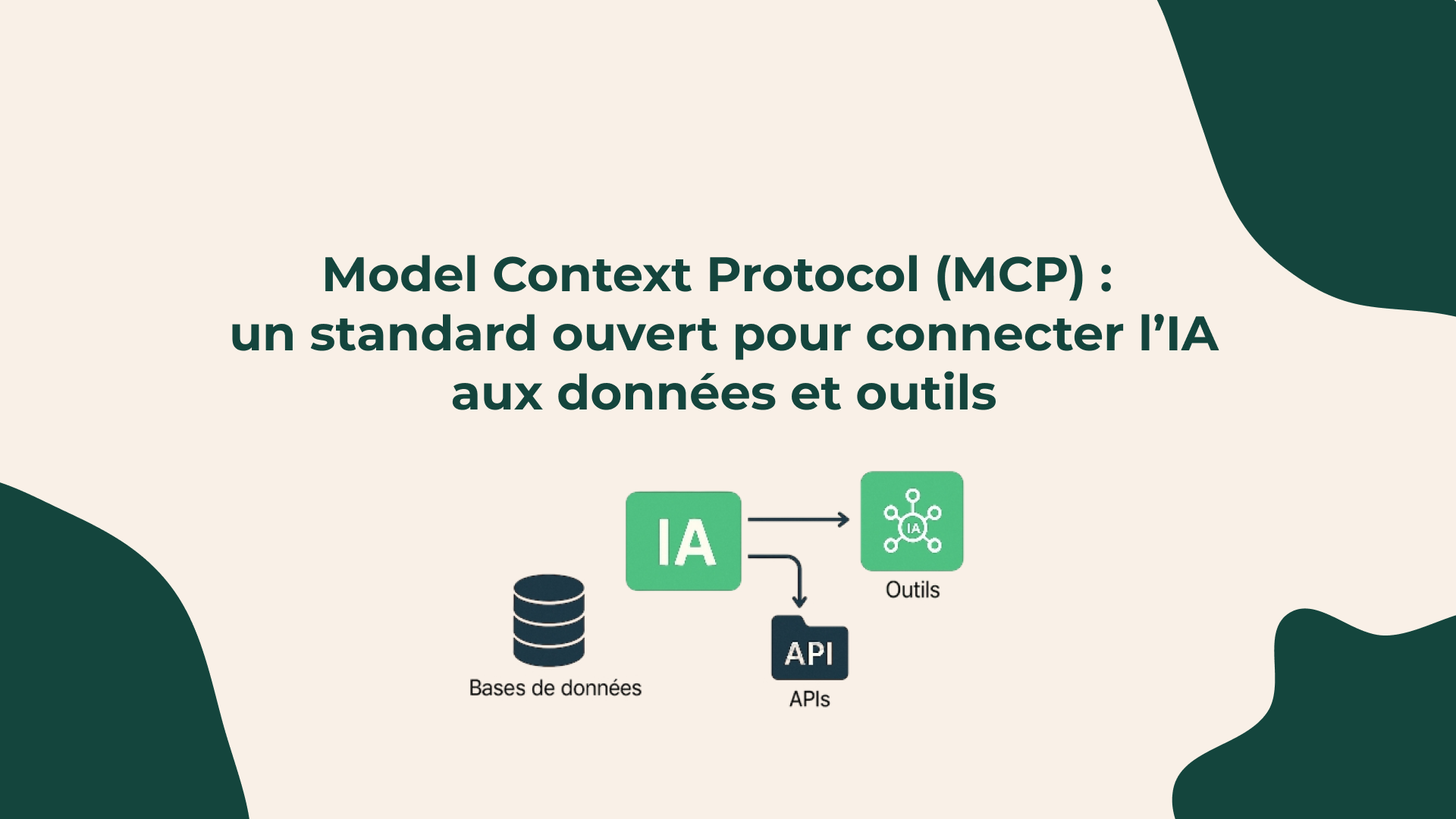
Model Context Protocol (MCP): an open standard for connecting AI to data and tools
AI assistants become more useful when they can retrieve data, work with files and interact with external services. The Model Context Protocol (MCP) provides a standardized way to connect AI applications with these resources.
What is MCP?
Model Context Protocol is an open protocol that allows AI applications to access tools and data sources such as databases, APIs, file systems and code repositories through a consistent interface.
A modular architecture
MCP commonly involves three main components:
- MCP host: the application where the AI experience runs, such as a chat interface or development environment.
- MCP client: the component that manages communication with MCP servers.
- MCP server: the service that exposes tools, resources or prompts connected to external systems.
Example workflow
- A user submits a request to the host application.
- The client discovers capabilities exposed by connected servers.
- The model selects an appropriate tool.
- The client sends the tool request to the relevant server.
- The server interacts with the external system and returns structured results.
- The model uses those results to produce the final response.
Why use MCP?
- Standardization: one consistent pattern for many systems.
- Modularity: servers can be added or replaced independently.
- Interoperability: AI applications can connect to databases, APIs, files and business software.
- Separation of responsibilities: integration logic remains outside the language model.
Potential applications
- Professional assistants accessing internal documents or CRM data.
- Development assistants reviewing repositories and proposing changes.
- Research tools querying internal databases.
- Automation agents interacting with multiple business systems.
Security and governance
MCP simplifies connectivity but does not remove security responsibilities. Organizations should control server access, permissions, credentials, logging, data exposure and approval rules for consequential actions.
Conclusion
MCP addresses a central challenge in AI application design: enabling models to interact with external tools through reusable and structured integrations. It can become an important foundation for connected enterprise AI systems.
the most common questions
MCP is an open protocol that standardizes how AI applications connect to external tools, resources and data sources.
It improves interoperability, modularity and reuse by reducing the need for a different custom integration pattern for every tool.
MCP servers expose structured tools that AI applications can invoke as part of workflows involving data retrieval or external actions.
Start with a limited use case, define permissions and security controls, select or build trusted servers and test all tool actions carefully.